
Hernia & Laparoscopic Mesh Surgery: What It Is, Why You Got It, and What Happens Next
Let's get one thing out of the way: if you've been diagnosed with a groin hernia and told you'll have a laparoscopic repair with mesh, that is good news, not scary news. It's one of the most common, safest, and most successful operations a guy can have. But nobody tells you the how or the what-happens-next, so let's do it properly.
The hernia, explained in plain terms.
A hernia is simply a gap or a weak spot in the muscular wall that's supposed to hold your insides in. Picture a tough fabric wall that's getting a bit worn — and something behind it keeps pushing. Where the wall gives way, a bit of intestine or fatty tissue bulges through.
Most hernias in blokes happen in the groin, and the one you're almost certainly dealing with is an inguinal hernia — it develops in the inguinal canal, the channel that runs down your groin. Trust me, it's a common spot. It doesn't mean you did anything wrong (more on that below). It just means the wall there isn't as strong as it used to be.
A hernia isn't a failure of you. It's a gap in the wall — and the fix is a patch that makes that wall stronger than it ever was.
Why do they happen?
There usually isn't one dramatic moment. It's a mix of things that add up:
- A weakness you were born with. Some guys have a naturally loose or open inguinal canal from birth. It may never bother them — until something stresses it.
- Pushing and straining. Heavy lifting, a big weight session, a long cough or sneeze, straining on the toilet, or being sick with an intense cough all spike the pressure inside your belly. Put that pressure against a weak spot enough times and things push through.
- Chronic cough, smoking, or being heavy. Smoking weakens the connective tissue over time, and a persistent cough or extra weight adds constant strain to the groin. These quietly raise your odds.
- Prior surgery or an old scar. An incision from a previous op can leave a weaker patch behind.
- Family history and age. The wall naturally gets less springy as you get older, and if your dad or a brother had one, you're more likely to.
None of that means you were careless. It's anatomy, gravity, and time — not a scoreboard.
The operation: laparoscopic repair with mesh.
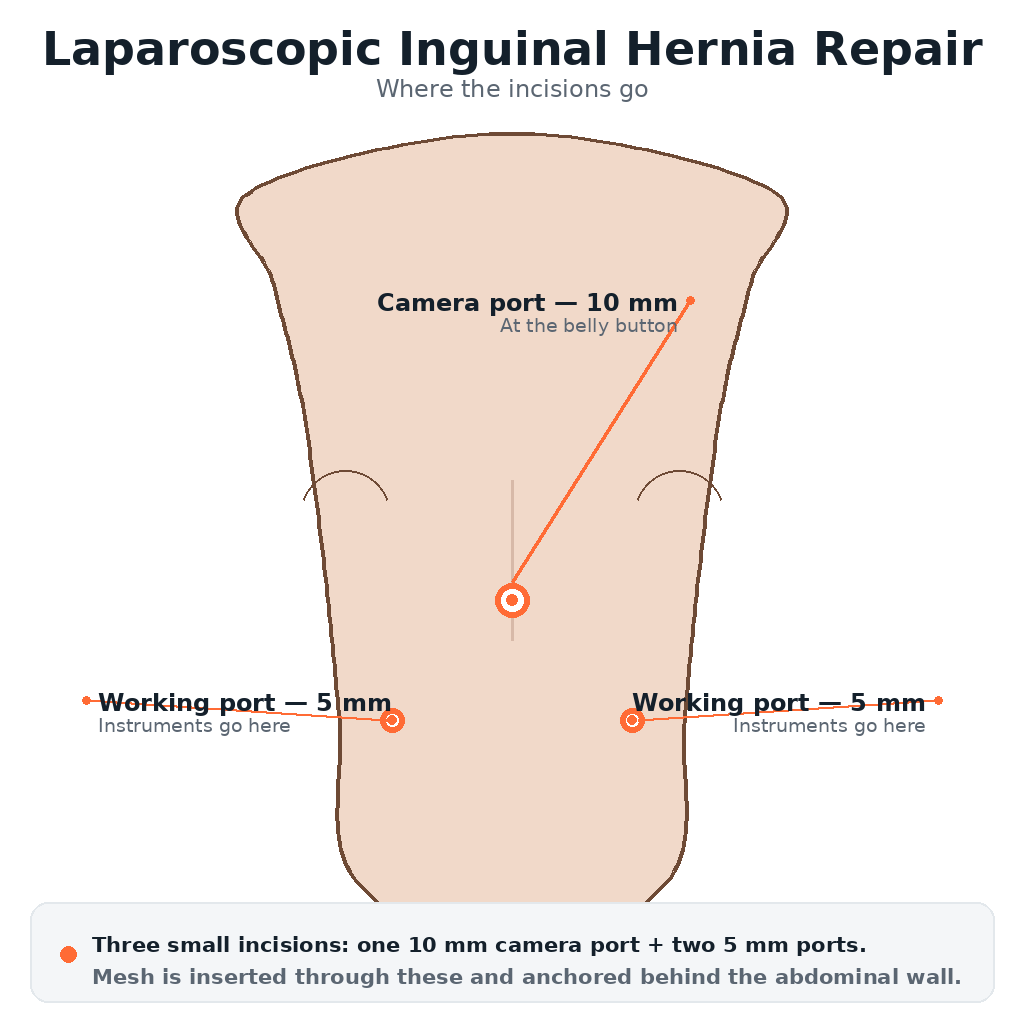
This is done under general anaesthetic, and it uses three tiny incisions instead of one big cut. One port at the belly button takes a small camera; two more ports in the lower belly carry the instruments. The surgeon operates through those keyholes, inflating the area gently so there's room to work.
Here's the specific bit — how the mesh is placed.
1. The surgeon brings the bulging part (the hernia) back into place, so the gap is clean.
2. A flat synthetic mesh — usually a lightweight polypropylene sheet, roughly the size of a postcard — is slid in and positioned behind the abdominal wall, in the preperitoneal space. That's the slim plane tucked just behind your muscle wall and in front of the lining that covers your organs.
3. It's spread to cover the entire defect plus a good margin (a few centimetres beyond the edges), then anchored in place with tiny absorbable tacks or a dab of surgical glue so it sits flat and can't wander.
4. That's it. The mesh does the heavy lifting from there: over the next few months your body's own tissue grows into it. That forms a strong, permanent reinforcement — the "bulletproof vest" your groin didn't have before. That's why mesh repairs have such low recurrence rates.
Because the repair is done from behind (preperitoneal), there's no big cut to heal and the mesh sits exactly where it's most effective. Some repairs go via the belly side (TAPP) and some stay completely outside the belly cavity (TEP) — but in both cases the idea is the same: a mesh patch placed behind the defect, over a wide area, anchored and left to integrate. Your surgeon picks the approach that fits you.
Recovery: what to expect.
Everyone heals at a different pace, but here's the realistic, no-BS version:
- The day of, and the day after. You'll go home the same day or the next morning. You'll be sore — that's normal. You'll have small dressings over the three sites. You'll be walking gently on day one. Peeing and taking normal breaths can feel a bit odd for a day or two; that passes.
- Soreness and swelling. Expect groin and lower-belly ache for the first few days, and maybe some swelling toward the scrotum. It settles over a couple of weeks. Ice on the sites (through the dressing, not directly on skin) helps.
- When you can go back to work. Desk-based jobs: often a few days to a week. Any job with more physical demand, plan on more time. Listen to your body — "pain that makes you wince" is the stop sign.
- Driving. Usually about a week, and definitely not while you're on the strong painkillers. You need to feel confident braking and twisting.
- The big rule: no heavy lifting. Most surgeons say keep lifting under about 10–13 lb and avoid intense core work for 4 to 6 weeks. Slow build back up after that. This is the one that actually matters — push too early and you can strain the area.
- The other big rule: don't get constipated. Pain meds and less moving around make you stop up, and straining pulls on the repair. Drink water, eat fibre, and use a stool softener if the doc suggests one. This is a real part of recovery, not an afterthought.
- Sex and intimacy. Once you're comfortable and pain-free with normal activity — often around 2 to 4 weeks, but your surgeon's guidance wins on this one. There's no rush.
- Follow-up. You'll see the surgeon around 2 to 6 weeks after. They'll check the sites and the repair.
When to actually call someone. Infection at a site (increasing redness, warmth, oozing, or a fever), severe pain that's getting worse, trouble peeing, or a rapidly growing, painful bulge — don't tough that out. Call your surgeon or go in.
Bottom line. A groin hernia is common and fixable. Laparoscopic mesh repair means a stronger groin, small cuts, and a recovery measured in weeks — not months. There is a small chance of recurrence or ongoing discomfort in a minority of cases, and it's worth talking that through with your surgeon, but for the overwhelming majority this is a routine, well-trodden operation. Get it fixed, follow the lifting rules, and you'll be back doing your thing. 💪
💪 Ballsy product picks
Men's health & grooming staples our readers trust. Affiliate links support the site at no extra cost to you.